

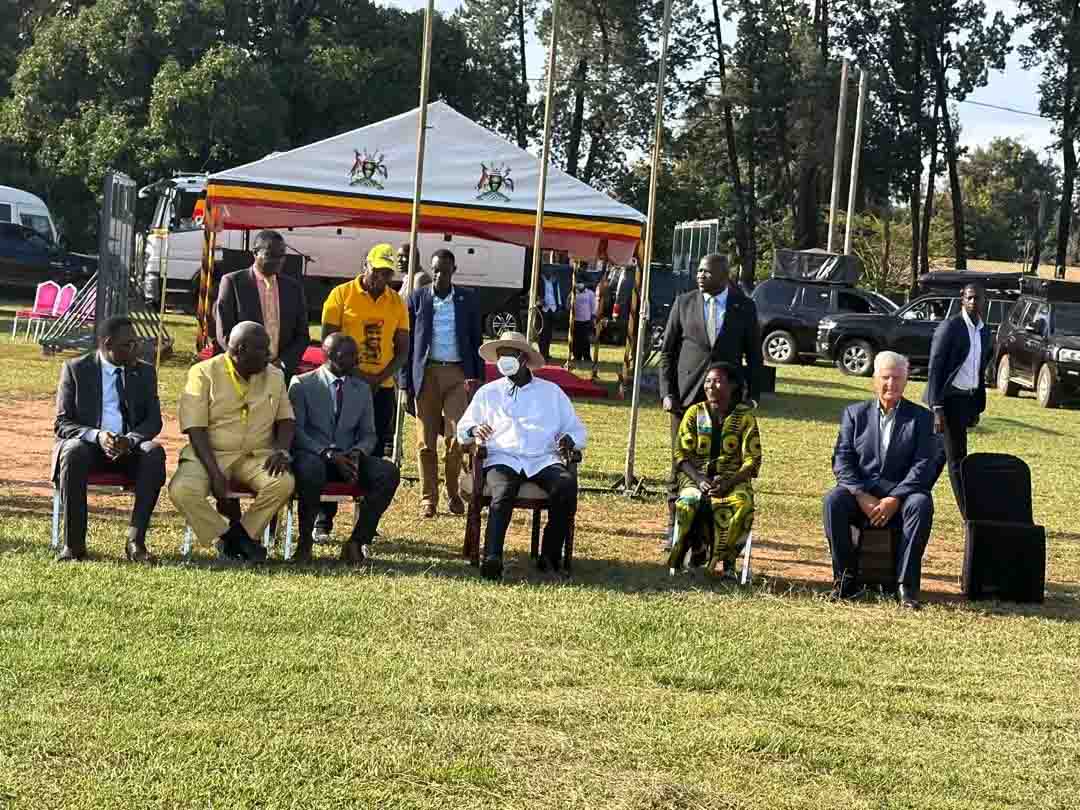

A meeting with President Yoweri Kaguta Museveni in Lira City. A nation’s journey under the National Resistance Movement. And the tragic loss of Joe Nam, whose final work forces Uganda to confront the question of continuity. In this deeply personal reflective eulogy, Amb. Dickson Ogwang-Okul presents a firm defense of NRM ideology while calling for thoughtful national engagement.
I did not expect that a moment of national reflection would so quickly turn into one of personal and collective mourning.

On Saturday the 18th, I stood in Lira City in the presence of His Excellency Yoweri Kaguta Museveni. It was a moment that carried with it the weight of history and the quiet confidence of continuity. As I listened and reflected, I could not help but think about the long journey Uganda has undertaken since 1986, a journey from instability to relative peace, from institutional collapse to structured governance, and from isolation to a respected position within the region and beyond.
That same journey forms the very foundation of my own work, Uganda Since 1986, a book that I wrote not as an abstract academic exercise, but as a deliberate testament to the transformation achieved under President Museveni’s leadership. I have consistently maintained, and I restate it here without hesitation, that I am a firm believer in the ideology of the National Resistance Movement, a loyal supporter of the President, and a committed proponent of what I have termed Museveniomics, the engine that has driven Uganda’s socio-economic transformation over the past four decades.
But by Sunday morning, the 19th, that sense of continuity had been overtaken by tragedy.
The news of the untimely and violent death of Joe Nam reached me with a weight that is difficult to fully convey. In that moment, his book, The Day Museveni Goes, ceased to be simply a political commentary. It became something far more profound, a final reflection, a closing argument, and, in many ways, a testament left behind.
Joe Nam’s work is built around a question that has long lingered, often unspoken, within Uganda’s national consciousness: what happens the day President Museveni leaves office? He approaches this question with seriousness and a clear awareness of Uganda’s past, particularly the painful history of violent political transitions that shaped the decades before 1986. His concern is not framed in abstraction; it is grounded in the lived experiences of a nation that has known instability, loss, and disruption.
In reading his work, one encounters a consistent call for preparedness, a call for dialogue, for constitutional order, and for a transition that is deliberate rather than reactive. Even where one may disagree with his conclusions, it is evident that his motivation was rooted in a concern for national continuity.
It is at this point that I must make a clear and deliberate distinction.
While I recognize the value of reflection that Joe Nam’s book invites, I do not agree with many of the views expressed within it. Much of the work, in my considered judgment, stands ideologically at variance with the principles of the National Resistance Movement and does not fully appreciate the depth and substance of the transformation that has taken place under President Museveni’s leadership.
My own book affirms that transformation. It documents a Uganda that was rebuilt, deliberately, steadily, and often against immense odds. It reflects a belief that the stability we enjoy today is not accidental, but the product of visionary leadership, disciplined state-building, and a coherent ideological direction.
And yet, it is precisely because of this grounding that I find it necessary, not optional, to engage with Joe Nam’s work.
As a diplomat, I have been shaped by the discipline of engagement. As a lawyer, I am trained to interrogate ideas. And as a patriot, I recognize that nation-building requires not only conviction, but also the maturity to listen—even when we disagree.
It is in this spirit that I offer this reflection, guided by a principle that I believe must remain central to our national discourse:
“I am a firm believer in the NRM ideology, a loyal supporter of President Museveni, and a proponent of Museveniomics, yet as a diplomat, I believe we must engage even those voices we disagree with to secure a peaceful and stable future for Uganda.”
That distinction is critical.
To engage is not to endorse.
To reflect is not to concede.
To listen is not to abandon conviction.
Joe Nam’s work, viewed through this lens, becomes part of a broader national conversation, one that must continue if Uganda is to preserve its gains while preparing responsibly for the future.
What gives this reflection an added weight, however, is the tragic manner of his passing.
There is a sobering irony, one that history will not easily ignore, that a man who wrote about the dangers of instability, who urged preparation for peaceful transition, and who called for national reflection, would himself fall victim to a violent and untimely end.
His voice has been silenced.
But his question remains.
As I reflect on that meeting in Lira, and the news that followed the next morning, I am reminded that nations are shaped not only by their leaders, but also by the voices that engage with their direction. Some voices affirm. Others question. But all, in their own way, contribute to the shaping of the national journey.
Joe Nam was one such voice.
We may not agree with all that he wrote. Indeed, I have clearly stated that I do not. But we cannot ignore the responsibility to engage with the questions he raised—particularly when those questions touch on continuity, stability, and the future of our nation.
In this sense, I do not see contradiction between our two works. I see a continuum.
Uganda Since 1986 tells the story of how far we have come.
The Day Museveni Goes challenges us to think about where we must go next.
Between them lies the responsibility of leadership, and the duty of citizenship.
In honouring Joe Nam’s memory, we are not called to adopt his views. We are called to reflect with clarity, to engage with conviction, and to remain anchored in the principles that have brought Uganda this far.
That is how nations endure. And, that is how we honour both the journey we have made, and the future we must secure.
May the soul of our brother Joe Nam Rest in Peace!
By Amb. Dickson Ogwang-Okul
Lawyer | Diplomat & Author of Uganda Since 1986: The Socio-Economic Transformation Journey Through the Eyes of a Foreign Service Officer