


By Chris Ocen – Health Worker, Journalist, IT Specialist
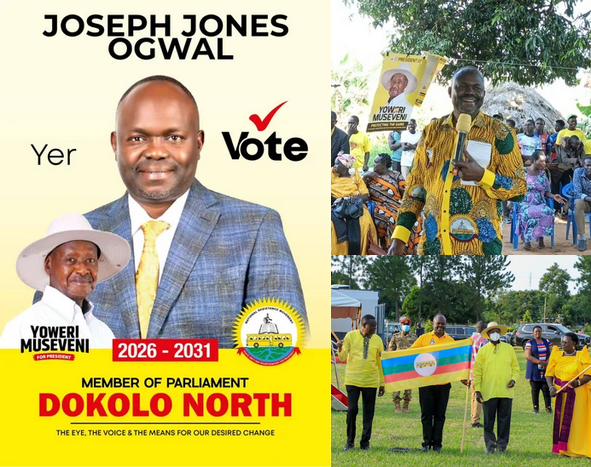
In Uganda’s political theatre, visibility is often mistaken for value. The loudest voices dominate headlines, yet the most effective leaders are often those quietly building structures, shaping communities, and delivering results far from the spotlight. Joseph Jones Ogwal, Dokolo North MP-elect, belongs to this rare class—a disciplined cadre, seasoned technocrat, and a deeply rooted grassroots mobiliser whose time has arrived at a critical moment in Uganda’s political journey.
His rise is not accidental. It is the product of over 15 years of deliberate mobilisation, strategic restraint, and sustained community engagement.
From Political Restraint to Electoral Strength
In 2021, at a time when internal competition within the National Resistance Movement (NRM) was intense, Ogwal made a defining choice—he stepped aside in favour of the party flag bearer. In Uganda’s political culture, such restraint is uncommon. But it revealed a leader guided by ideology, patience, and long-term calculation.
Years later, that patience translated into political strength.
In the last NRM primaries, Ogwal secured 5,964 votes, defeating incumbent Moses Ogwal Goli (4,915 votes) in a race declared free, fair, and peaceful. Other contenders trailed behind. When petitions were filed challenging his victory, the NRM Election Disputes Tribunal dismissed them due to lack of credible evidence—effectively confirming him as the undisputed flag bearer.
He did not just win an election—he consolidated legitimacy.
A Mobiliser Forged Over 15 Years
Long before his electoral victory, Ogwal had already built one of the most structured and resilient grassroots mobilisation networks in Dokolo North.
For over a decade and a half, he has actively mobilised for Yoweri Museveni and the NRM using practical, people-centered approaches. His mobilisation strategy has not relied on rhetoric, but on consistent presence and community investment.
His mobilisation architecture includes:
Sports as a mobilisation engine – Organising football tournaments such as Christmas Cup, Easter Cup, Eid, and Independence competitions, transforming them into platforms for youth engagement, unity, and talent development.
Youth empowerment structures – Building trust among young people through continuous engagement, mentorship, and opportunity creation.
Women-focused economic mobilisation – Supporting savings groups and livelihood initiatives that double as grassroots mobilisation networks.
Community presence beyond elections – Maintaining year-round engagement, reinforcing loyalty and credibility.
This long-term investment explains why his political base is not temporary—it is deep, organised, and sustainable.
Mobilisation That Delivers Results
Ogwal’s mobilisation is not symbolic—it produces measurable outcomes.
His victory over an incumbent MP demonstrated the strength of his grassroots network. Beyond that, his influence has extended across political lines. In Agwata Town Council, over 60 youth defected from opposition ranks to join the NRM, openly citing his leadership, energy, and clear development vision.
Even in moments of contestation, Ogwal has demonstrated maturity. After legal challenges to his victory were dismissed, he extended an olive branch to his opponents, calling for unity and collective focus on development.
This is not just mobilisation—it is leadership consolidation.
Mobilisation Through Development
What distinguishes Ogwal is his ability to tie mobilisation directly to tangible development interventions. His community-driven approach integrates economic empowerment, youth engagement, education advocacy, and social transformation into a unified model of leadership.
He has supported economic initiatives such as the donation of 300 birds to the Dokolo Journalists Development Association, boosting their poultry project as a sustainable source of income, while also investing in youth programmes through the provision of sports equipment, logistics, and incentives that keep young people actively engaged.
His advocacy for education reform highlights the stark reality that only one in nine children in Dokolo North progresses to secondary school, a challenge he addresses through practical, solution-oriented strategies, including plans to train five doctors and about 30 nurses from within the community.
At the same time, he has spearheaded environmental and sanitation efforts such as the “Keep Dokolo Clean” initiative, while consistently engaging communities—especially the youth—on road safety and civic awareness.
Further strengthening this engagement, Ogwal has delivered visible infrastructure and service improvements across the constituency. He has funded bridges construction with 12 culverts for a road connecting Alapata (Dokolo) to Alebtong, 8 culverts enabling swamp crossing between Apenyo (Bata) and Olemkere (Alebtong), and another 8 culverts over River Abalang linking Abenyo and Awiri (Dokolo) to Kalaki (Teso), significantly improving accessibility and connectivity.
His work also extends to public safety and social welfare, including the distribution of over 300 reflector jackets to boda boda riders, provision of 43 branded sports uniforms across all 43 parishes, and the repair of 30 boreholes alongside 20 community springs to improve water access.
He has further supported education through bursaries for four university students and demonstrated solidarity with communities by contributing to burials during times of loss.
In preserving cultural identity, he has actively promoted Lango heritage through drumming (goyo bull) and supported cultural groups such as Iguli Atar and Odiye Naka Obilo, including sponsoring Iguli Atar to a winning performance in Mukono.
Additionally, his provision of eight slashing machines per sub-county has strengthened school maintenance efforts, with the Adok sub-county machine remaining operational for over five years.
This integrated model transforms mobilisation into a vehicle for development, not just political support.
A Scientific Mind in Leadership
Ogwal’s leadership is further distinguished by intellectual depth.
When floods affected Dokolo, he provided a science-based explanation, linking the disaster to climate change and the Indian Ocean Dipole. He dismissed misinformation and explained how global weather systems influence rainfall patterns in East Africa.
In a political environment often driven by speculation, this ability to bring scientific clarity to public discourse is both rare and necessary.
Technocrat Meets Grassroots Leader
Beyond mobilisation, Ogwal brings over 24 years of professional experience in energy, environment, and natural resource management.
He has contributed to over 40 high-voltage electricity transmission and substation projects across Uganda, working with international development partners such as the World Bank and African Development Bank.
His expertise spans: Environmental and social safeguards, infrastructure compliance and planning, community resettlement frameworks and ecosystem restoration and conservation.
Earlier in his career, he reviewed over 100 Environmental Impact Assessments and conducted more than 500 environmental compliance inspections.
This dual identity—as a technocrat and grassroots mobiliser—is what sets him apart.
A Manifesto Built from Experience
Ogwal’s six-pillar agenda reflects both his professional background and grassroots engagement:
Education – Scholarships, establishment of a vocational skilling centre, and a girl-child empowerment program involving the donation of 10 sewing machines to each sub-county/town council for hands-on training.
Economic empowerment – Strengthening household incomes and overseeing effective penetration of government programs such as Parish Development Model (PDM).
Oversight on infrastructure – Ensuring improved service delivery and accountability in roads, electricity, and public works.
Sports and culture – Promoting unity, talent development, and cultural identity through structured sports initiatives.
Advocacy – Championing environmental protection and reproductive health awareness at community level.
Governance and accountability – Supporting transparency, anti-corruption efforts, and responsive leadership aligned with national priorities.
These priorities are not theoretical—they are rooted in lived realities and practical experience.
A Leader for a Critical Moment
As Uganda gradually approaches a phase of political transition, the country requires leaders who are balanced, focused, and deeply connected to the people. Leaders who understand both systems and society—those capable of sustaining stability while advancing transformation.
Ogwal represents such a leader.
His vision aligns with that of Yoweri Museveni—particularly on fighting corruption, strengthening systems, and advancing a development-oriented agenda. Yet his strength lies in how he localizes that vision into practical, community-driven action.
A Leader Aligned with Uganda’s Development Needs
Uganda’s development trajectory increasingly demands leaders who can: Mobilise communities effectively, manage complex systems and translate policy into results.
Ogwal fits this profile with precision.
He has demonstrated: 15+ years of sustained grassroots mobilization, electoral strength against incumbency, ability to unify across political divides, commitment to development-driven leadership and technical expertise in key national sectors.
This is not just a constituency leader—it is a leader whose capacity reflects the kind of balanced, people-centered, and results-driven leadership Uganda needs at this critical stage of its growth.
From Unknown to Indispensable
Joseph Jones Ogwal, Dokolo North MP-elect, represents a new generation of leadership in Uganda—leaders who rise not through noise, but through networks; not through promises, but through performance.
He is a mobiliser who understands people, a technocrat who understands systems and a leader who understands delivery.
At a time when the country needs steady, development-minded leadership grounded in both experience and grassroots realities, Ogwal’s emergence is not just timely—it is necessary.
As Lango’s generation has changed over time, the youth are now seeking leaders who better understand their needs and aspirations.
The question is no longer whether he is ready.
The real question is whether Lango—and Uganda at large—is ready to embrace leaders shaped by substance, discipline, and results.


