


By Joshua Kyalimpa in New York
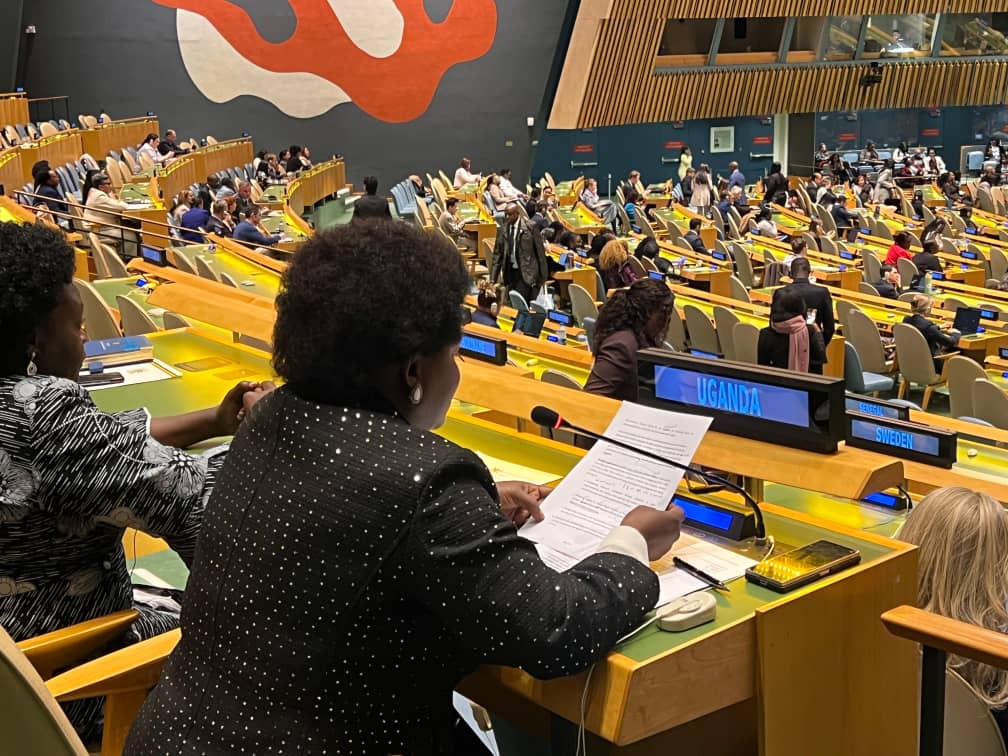
Uganda has called for strengthened and coordinated global and national action to end violence against women and girls, noting that while progress has been made, significant challenges remain. Speaking during a high-level dialogue on ending violence against women and girls at the United Nations, Hon. Betty Amongi Ongom said Uganda has made notable advancements in addressing Gender-Based Violence (GBV), but more work is required to eliminate the vice completely.
The dialogue, organised by UN Women during the 70th Session of the Commission on the Status of Women (CSW70), provided an opportunity for member states to present progress made in their respective countries in the fight against violence targeting women and girls.
Hon. Betty Amongi Ongom, who is leading the Uganda delegation, told the global gathering that a comprehensive approach that combines strong legislation, community engagement, public education, and adequate resources for the justice system is essential to significantly reduce violence against women and girls.
“Ending violence against women and girls requires sustained commitment and collaboration across all sectors,” she emphasized.
In her opening remarks, Sima Bahous, Executive Director of UN Women, described ending violence against women and girls as both “its own imperative and an accelerator” for achieving other development goals. She noted that the challenge continues to evolve due to emerging factors such as armed conflicts and rapidly advancing technology.
Uganda has implemented several legislative and policy measures to combat violence against women and girls. Key among these is the Domestic Violence Act (Uganda, 2010) and its accompanying Regulations of 2011, which provide a legal framework for protection against domestic violence
Other important laws cited by Hon. Amongi include:
• Prohibition of Female Genital Mutilation Act (Uganda, 2010), which criminalizes Female Genital Mutilation.
• Prevention of Trafficking in Persons Act (Uganda, 2009), addressing the critical issue of human trafficking.
• Succession (Amendment) Act (Uganda), which seeks to eliminate historical discrimination in property and inheritance rights affecting women and girls.
• Employment (Amendment) Act (Uganda, 2023), which strengthens workplace protections against sexual harassment.
Uganda has also adopted important policy frameworks, including the National Action Plan on Women (2007) and the National Policy on Elimination of Gender-Based Violence (Uganda, 2019), which guide national, district, and community-level responses to gender-based violence. Beyond legislation, the country has introduced a range of institutional and programmatic interventions aimed at strengthening access to justice for survivors. These include specialized court sessions established by the Judiciary to reduce case backlogs, the Justice for Her Project launched in 2025 to expedite GBV cases and promote victim-centred justice, and continuous training of police officers.
Specialized police units such as the Child and Family Protection Unit (Uganda Police Force) have also been established to handle cases related to domestic violence and child abuse. In addition, recent initiatives have focused on increasing male engagement in efforts to prevent violence against women and girls.
Despite these advancements, Hon. Amongi noted that several challenges continue to hinder progress.
She pointed out that although reporting of GBV cases has increased, investigation and conviction rates remain relatively low, with only about 26.6% to 27% of reported cases being investigated and taken to court.
Commission on the Status of Women Conference 2026