

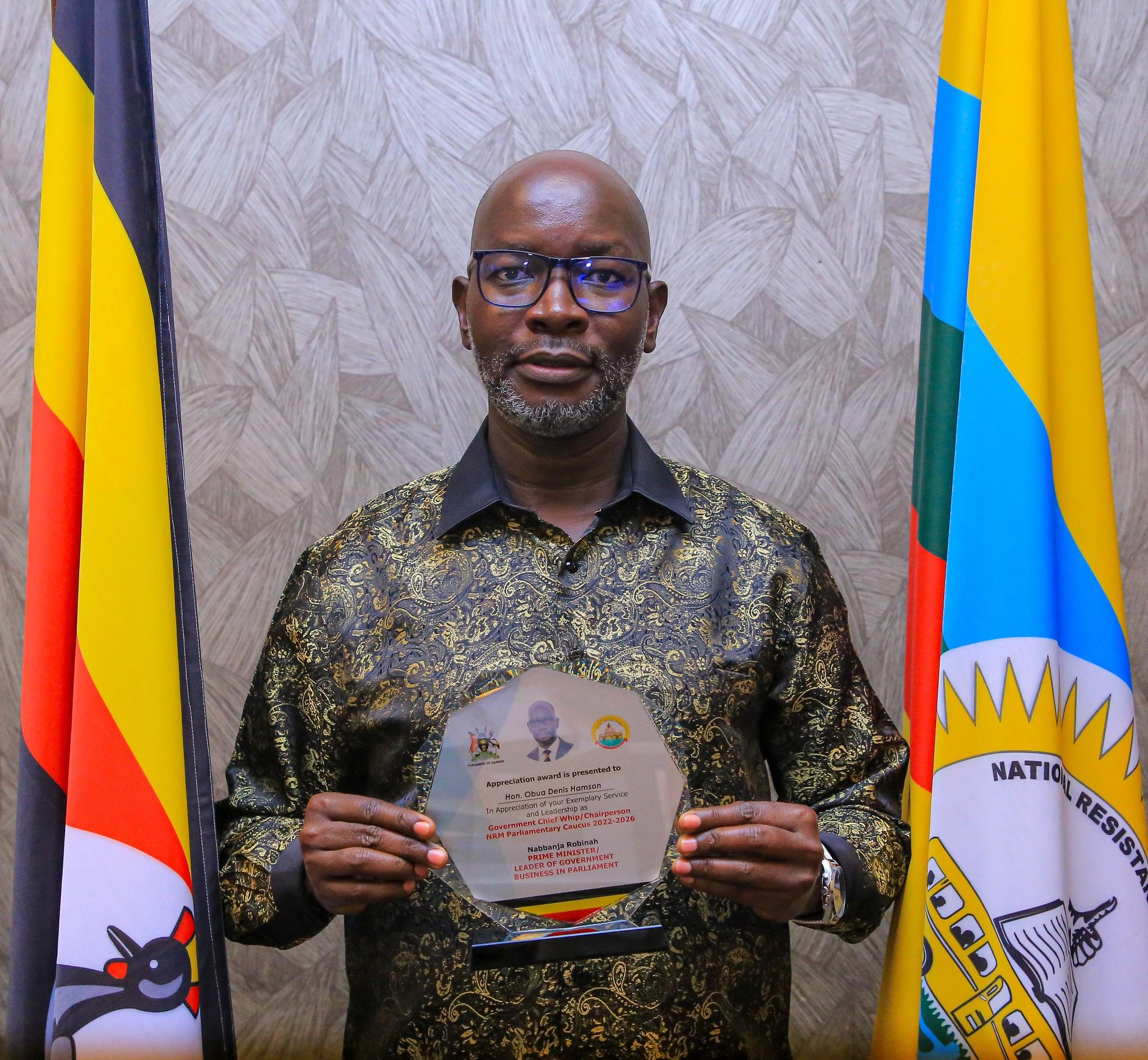

Government Chief Whip Denis Hamson Obua has commended the National Resistance Movement Parliamentary Caucus for their commitment to strengthen coordination, legislative efficiency, and service delivery
He said unity, teamwork, and strategic leadership are pivotal in advancing Government programmes and ensuring effective representation of wananchi in Parliament.

It was during a review meeting for the Executive Committee and Regional/Zonal Whips of the NRM Parliamentary Caucus on Friday.
Obua also received Appreciation award for his exemplary service and leadership as Government Chief Whip.
He noted that the NRM Government remains committed to enacting progressive legislation aimed at improving livelihoods, strengthening institutions, and accelerating Uganda’s socio economic transformation.

He added that several reforms have been undertaken by Government, including those in the coffee sector, were intended to improve efficiency and enhance service delivery to citizens.
“Our reforms are always guided by the national interest and the desire to create stronger systems that better serve Ugandans,” he said.
He noted that regional and zonal whips play important roles in mobilizing support for Government business in Parliament and maintaining cohesion within the Caucus.
“There is need for continuous stakeholder engagement and effective communication to help the public better appreciate the intentions and benefits of key Government policies and legislation,” he added.
He said on legislative matters, referenced recent laws and Bills debated by Parliament, including the Uganda People’s Defence Forces (Amendment) Bill, 2025 and the Protection of Sovereignty Bill, 2026, are aimed at strengthening national security, protecting constitutional order, and safeguarding Uganda’s sovereignty.
He applauded members of the Executive Committee and the institution of Parliament for the positive cooperation that enabled legislative successes.
The review meeting provided an opportunity for leaders within the Caucus to reflect on achievements, discuss emerging priorities, and strengthen strategies for improved legislative coordination and national service delivery.